
My Role: Product Designer
Company: Clear Match Talent, tech recruiting agency
The Team: 1 product designer (me), CTO, 2 Co-Founders on conception→0
AI Tools: Claude, Figma Make
Target Users: Agency recruiters that maintain 500+ relationships
My Contribution: Ran a one-week AI experiment that replaced 3 months of planned development and redirected the product roadmap. Led product scoping, designed the priority matrix algorithm, mapped the backend architecture, and built the prototype using vibe coding and Figma Make.
Case Study Timeline: 3 months
“I have hundreds of warm contacts, but I only reach out when there’s a job. It’s hard to keep things warm in between.”
— Agency Recruiter
User Problem
The Struggle to Maintain 100s of Relationships at Once
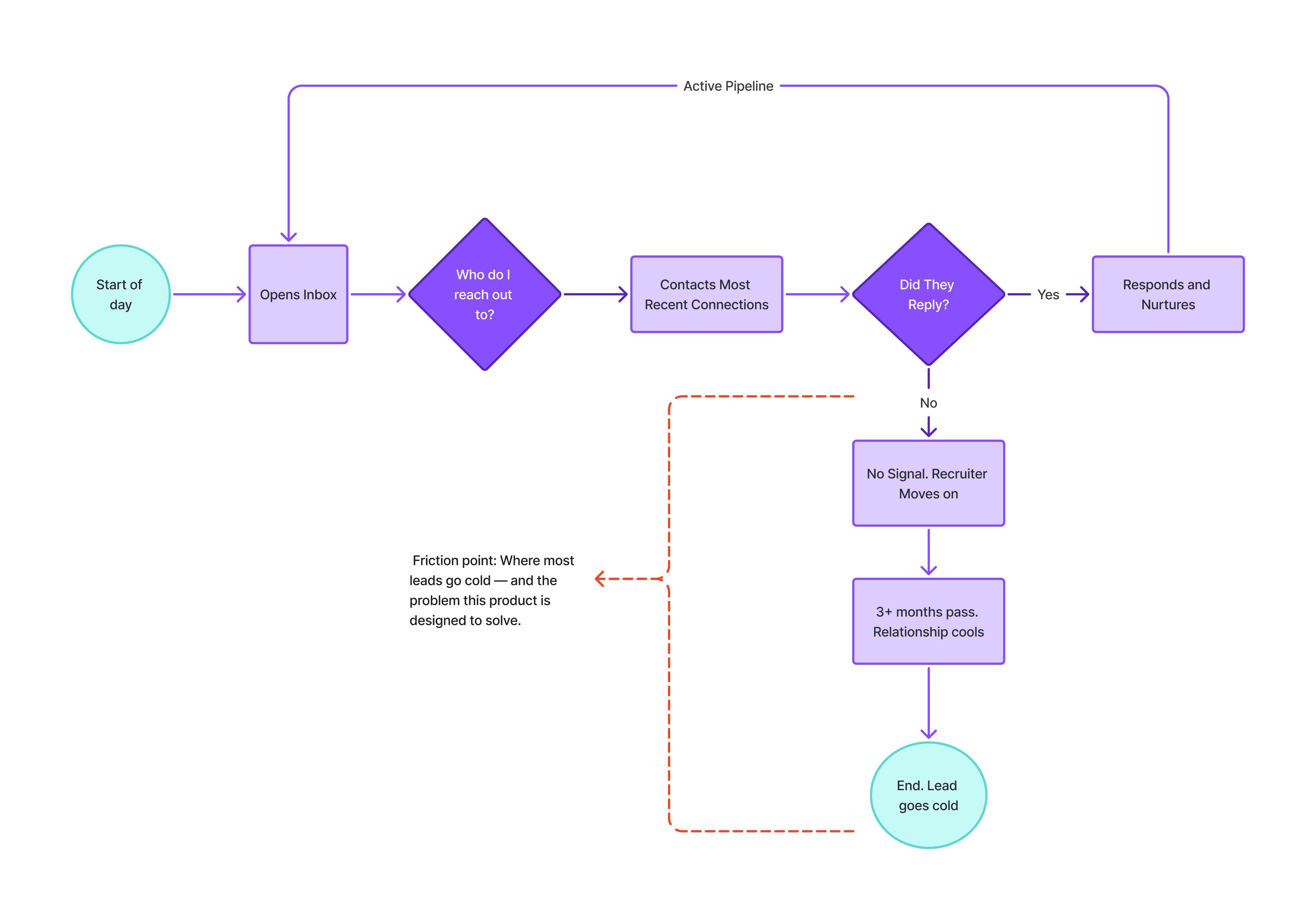
Warm leads go cold because there's never enough time to stay in touch with everyone. Recruiters manage hundreds of relationships at once, but they naturally gravitate toward whoever they spoke to most recently. Anyone untouched for 3+ months quietly drops off. By the time a job opening comes up, the relationship isn't warm enough to act on.
The intent is there. The bandwidth isn't
How might we help recruiters maintain warm relationships at scale, so no lead goes cold just because there wasn't enough time to reach out?
Mapping the Current State to Highlight Where Leads Go Cold
Leading Early Product Roadmap Discussions: What is This Product?
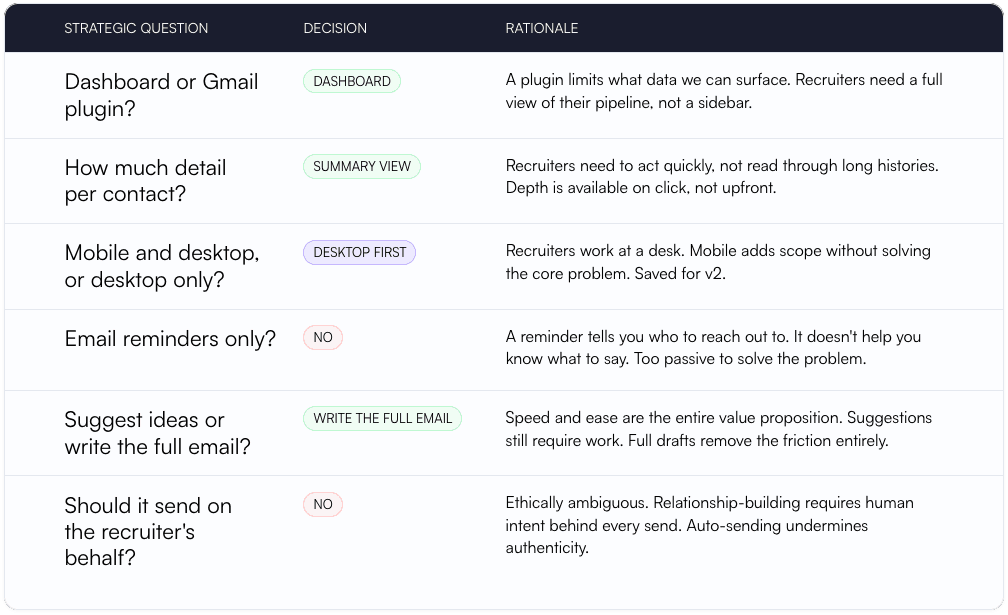
Before any wireframes, I led early sessions with the co-founders asking the questions the team hadn't asked yet. These conversations shaped what the product was — and what it wasn't.
what are the core features and How will it function?
Conceptualizing the Product, From Initial Discussions to First Drafts
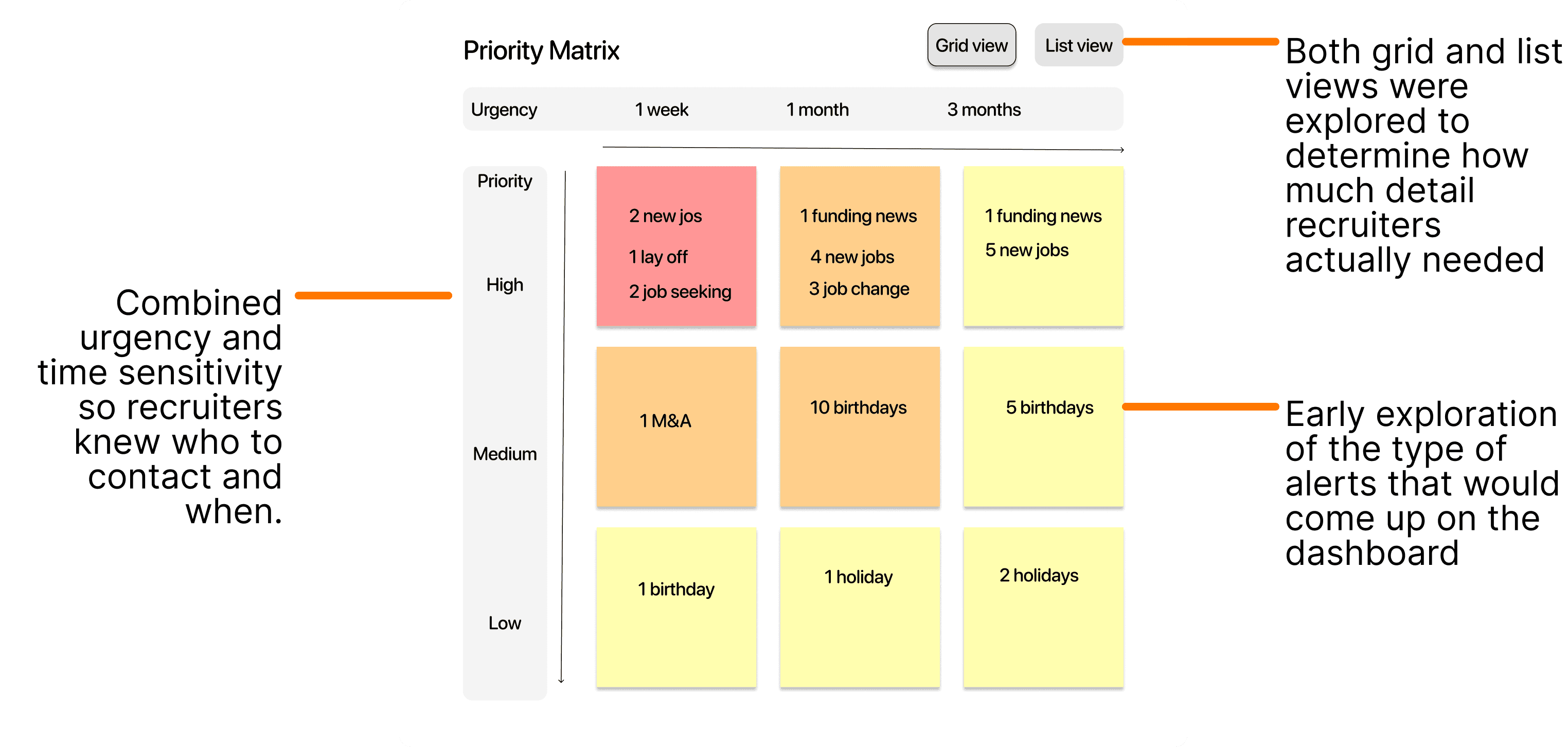
What Does a Recruiter Need to See First? Is It a Dashboard? Testing Revealed Answer is Yes.
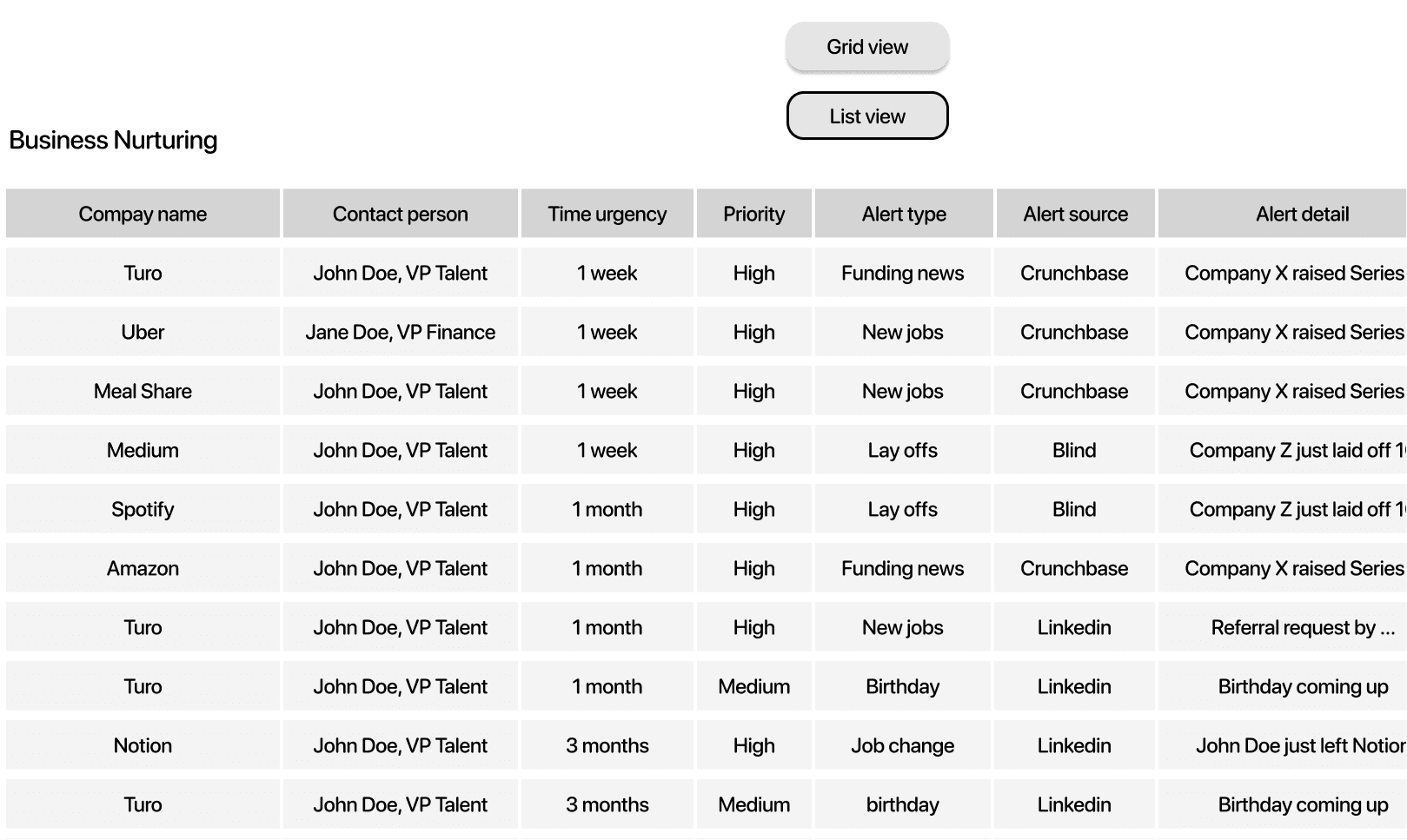
AI Recommended Messaging: Early Exploration
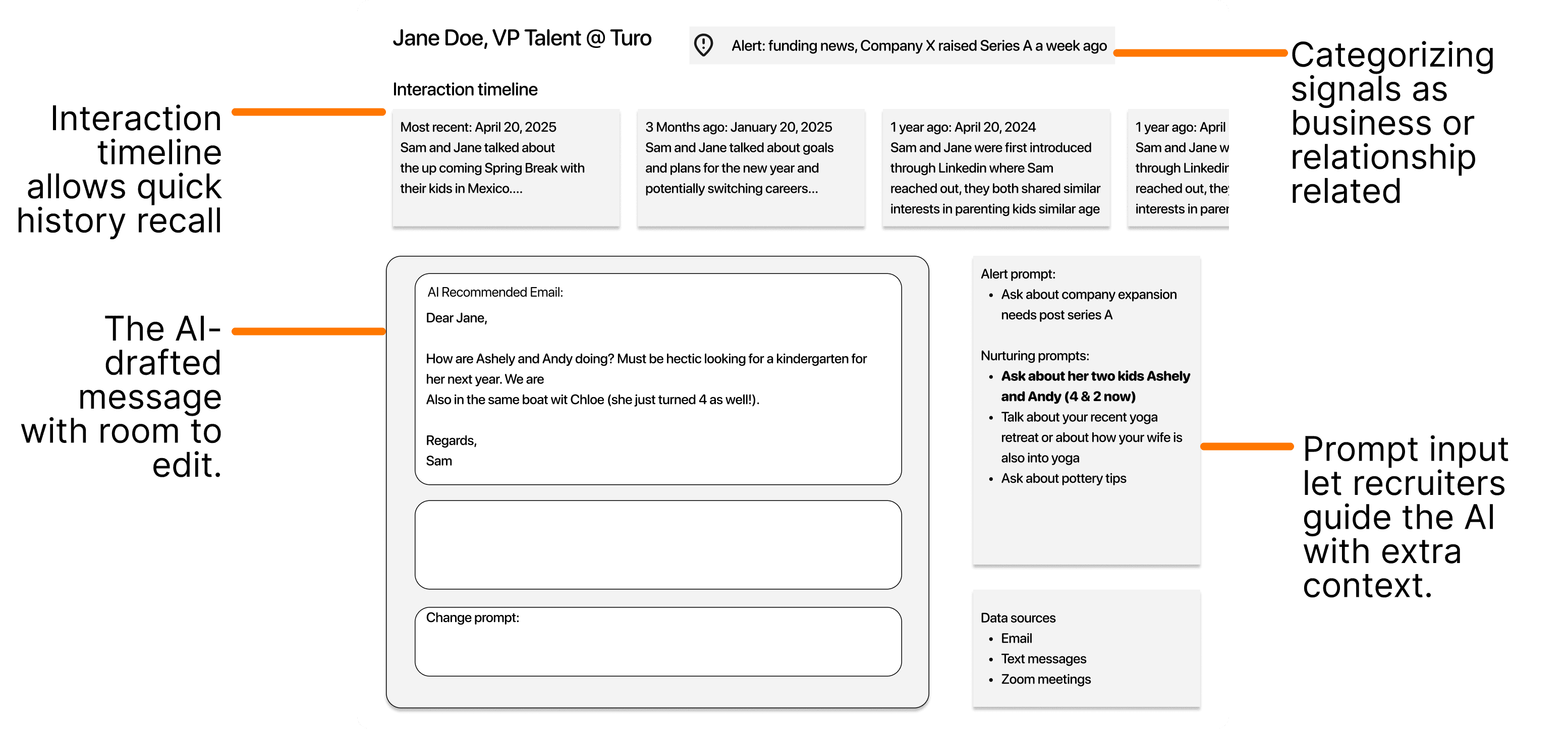
Exploring The Potential Need For a List View; Cut After Testing
A rough list view prototype to test whether a detailed table was needed. Testing confirmed recruiters didn't need this level of detail, the grid view and priority score told them everything they needed to act.
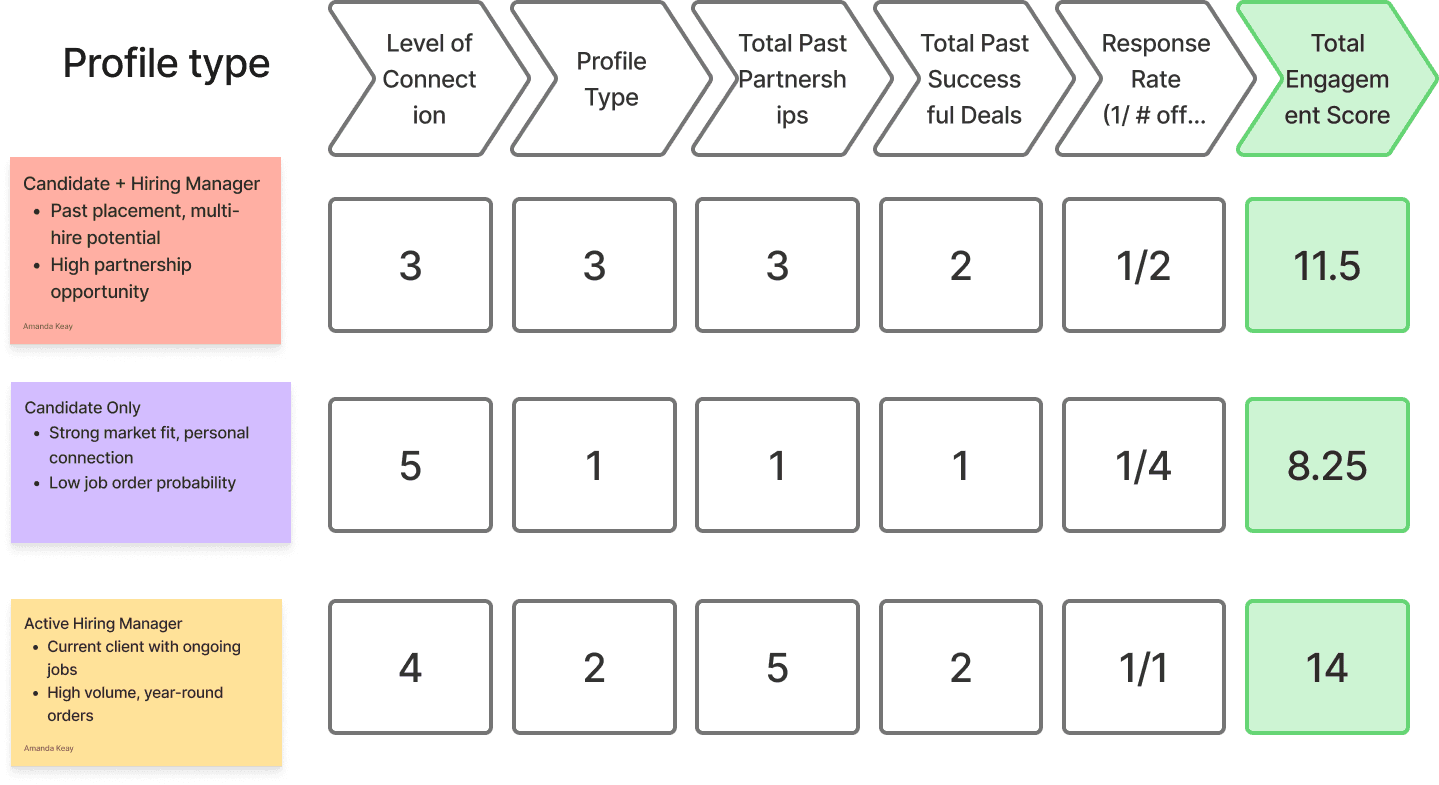
Building the Engagement Score Algorithm, The Formula that AI Uses to Rate Relationships
Defined a 5-variable scoring model with the CTO to calculate each contact's total engagement score; determining how urgently a recruiter should reach out.
Designing the Backend to Support AI
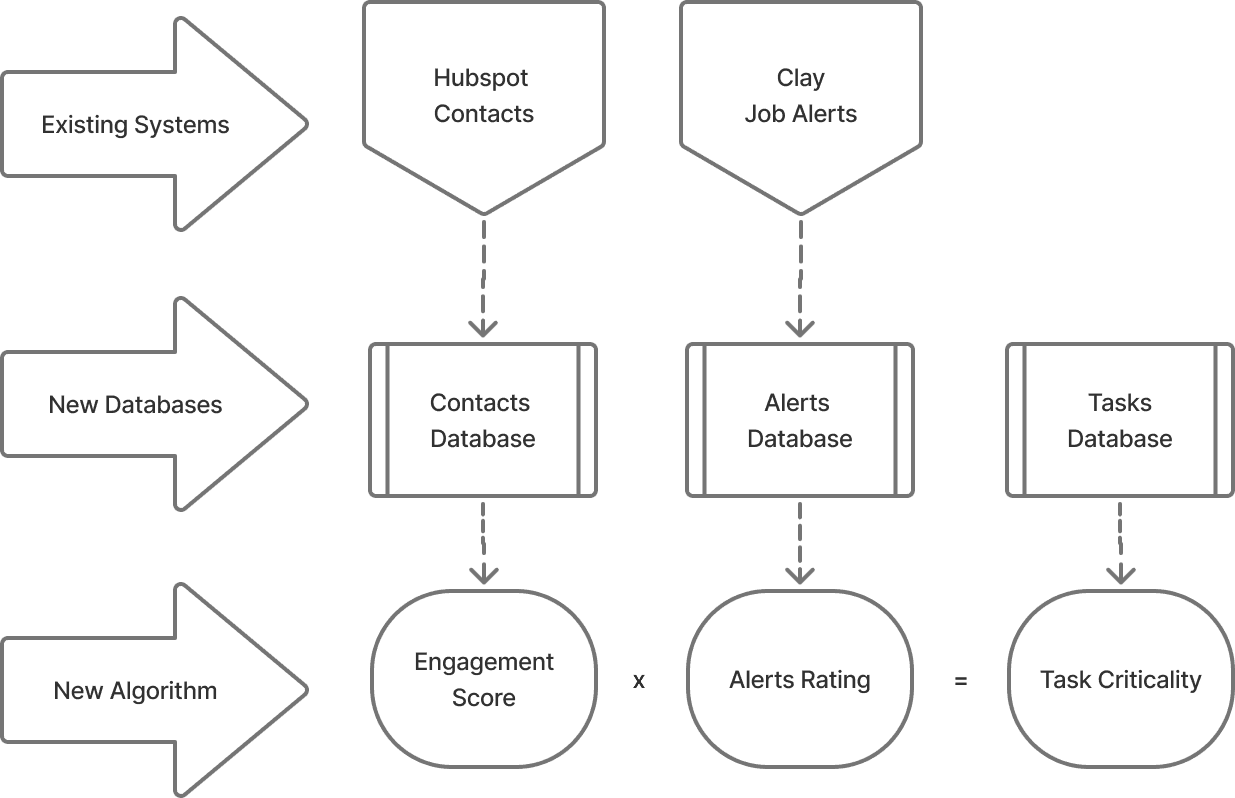
Mapped the backend architecture with the CTO; connecting existing tools (HubSpot and Clay) into three new databases that feed the core algorithm: Engagement Score × Alert Rating = Task Criticality.
Stamping the Core Product Requirements
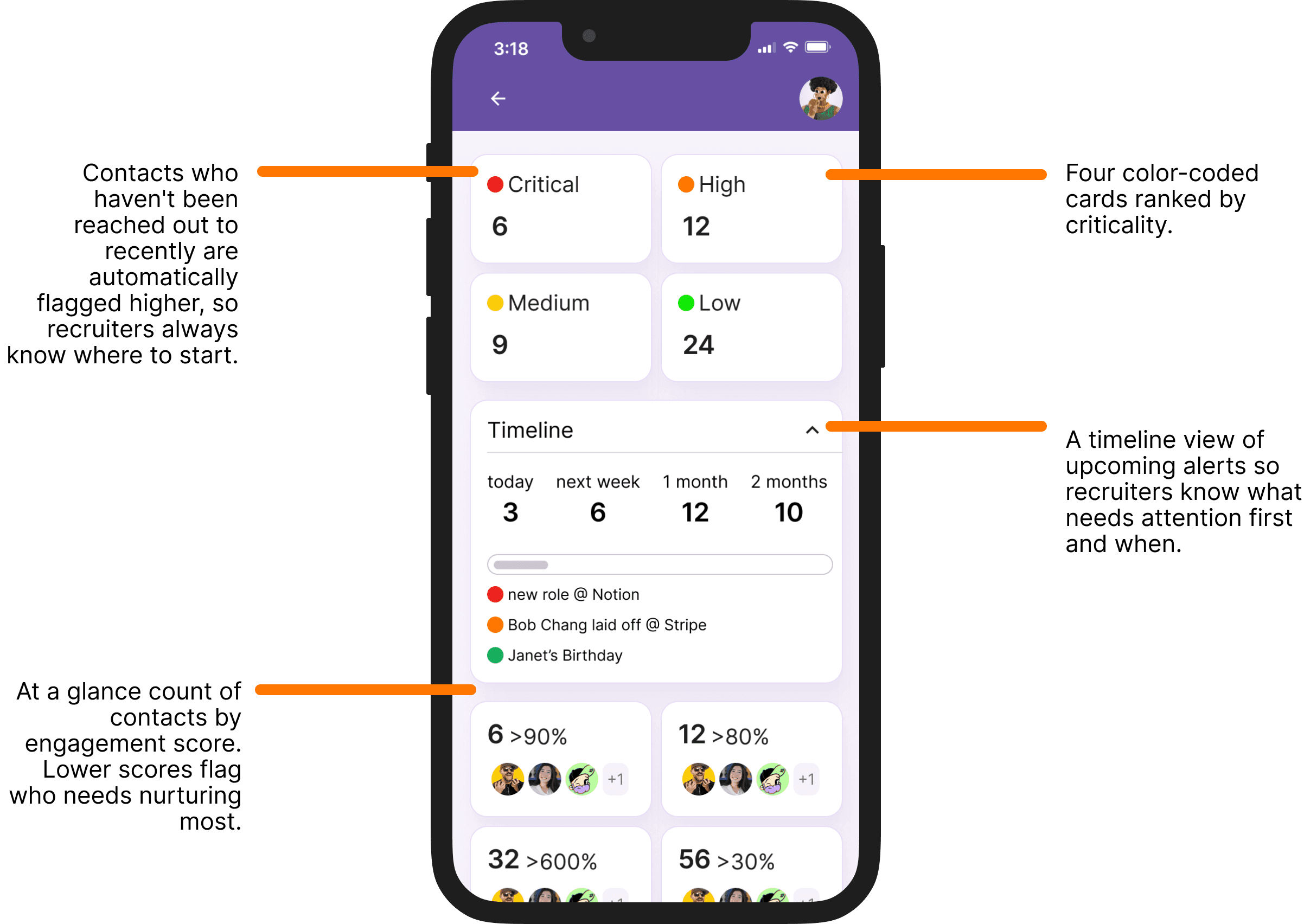
The priority matrix - immediate clarity on who to contact and when, so recruiters always know where to start
The AI-drafted message - references personal details and conversation history to sound human, not automated. Recruiters could send it with minimal edits
Interaction history - instant context on past conversations so every outreach feels personal before a single word is typed
Simpler was always better, cutting out redundancies:
List view removed - recruiters wanted to act, not read through signal details
Alert type labels removed - the priority matrix already communicated urgency without an extra categorization layer
Prompt input field removed - the AI synthesized context well enough on its own. Adding a prompt step created friction instead of removing it
From Concept to High Fidelity: Designing the Priority Matrix and AI Recommended Messages
1
Priority Matrix Dashboard
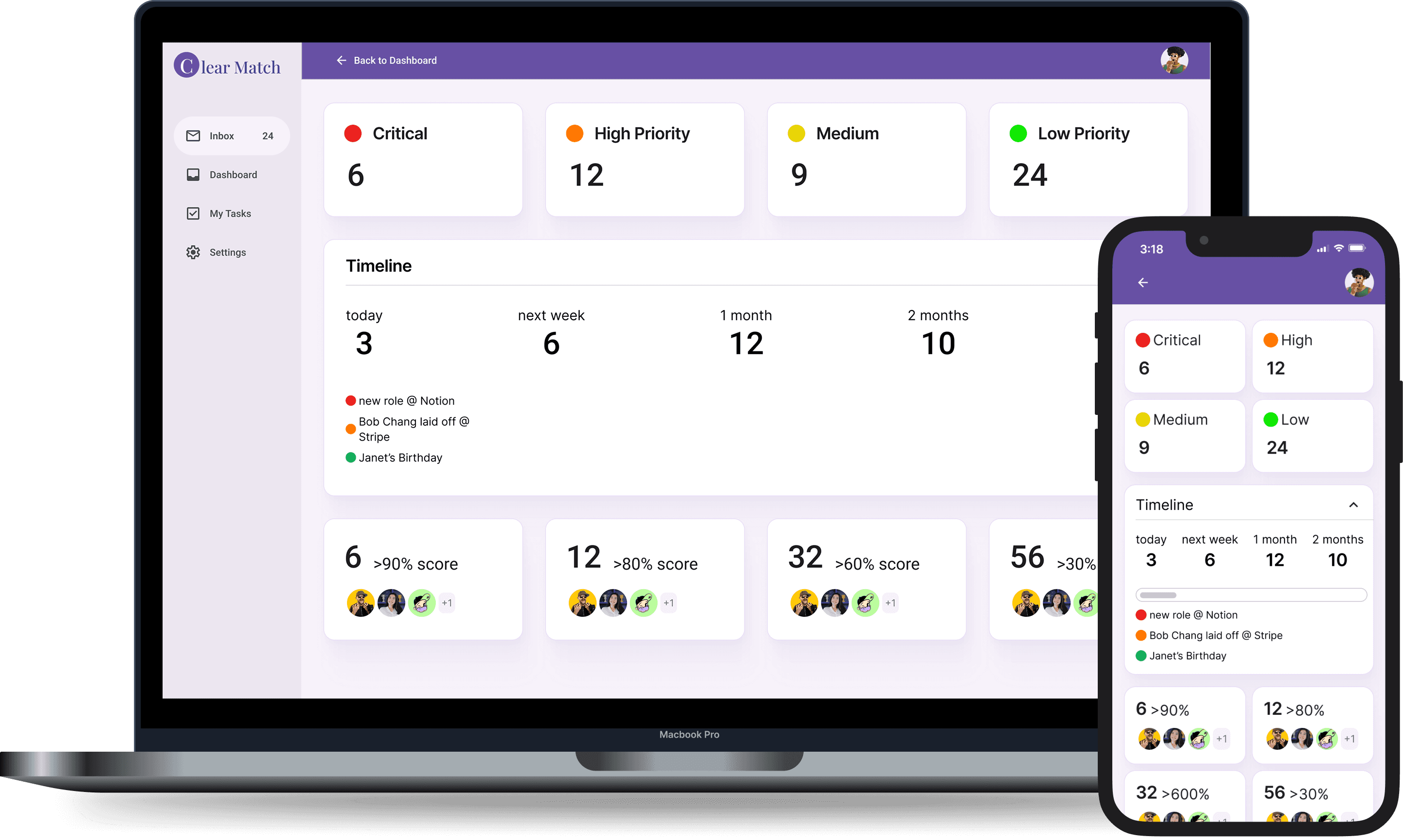
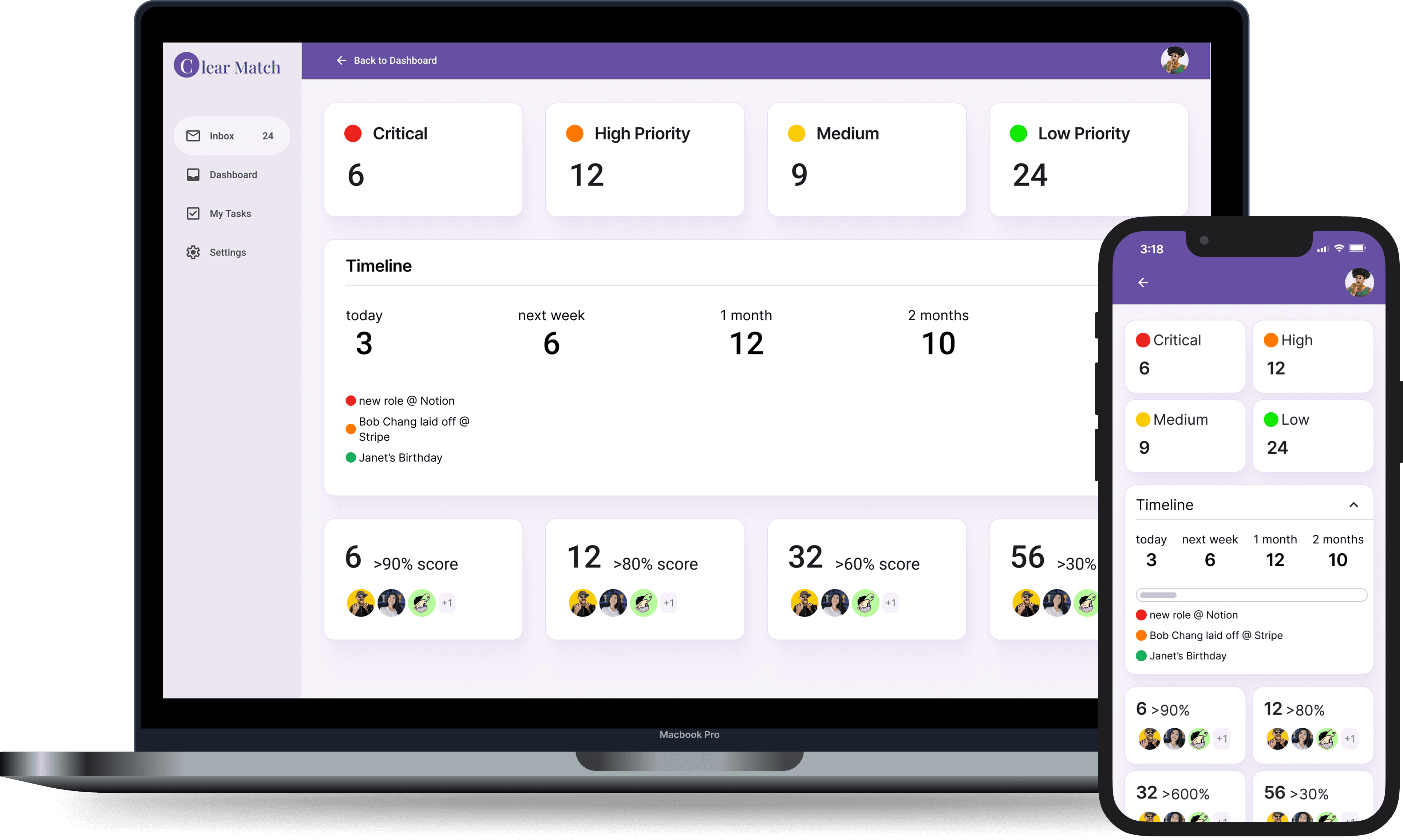
Summary of prioritized tasks and timeline of when tasks are due so recruiters act on the most critical items first
Summary of contacts by engagement score so recruiters know which relationships are getting cold
2
AI Recommended Messages
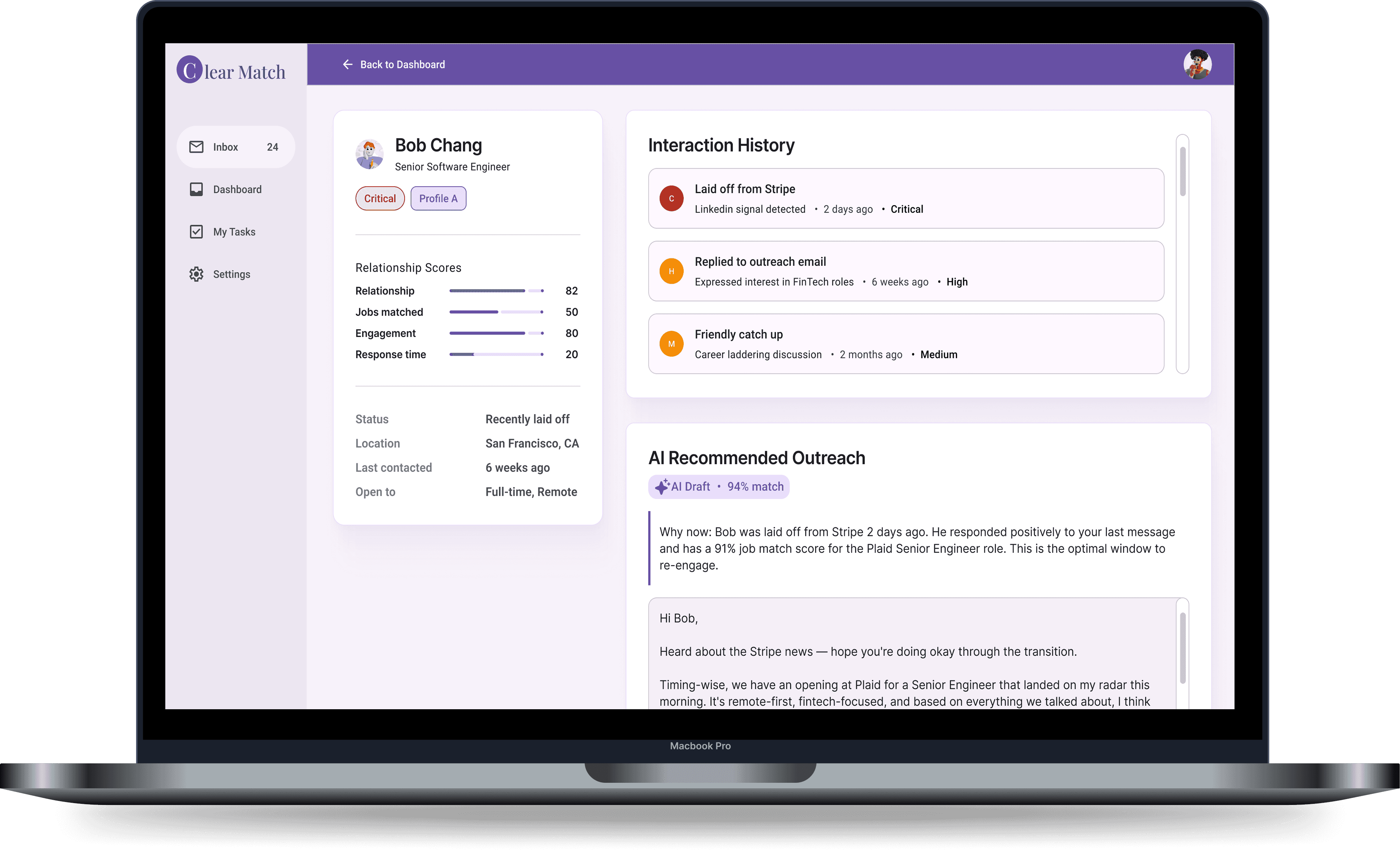
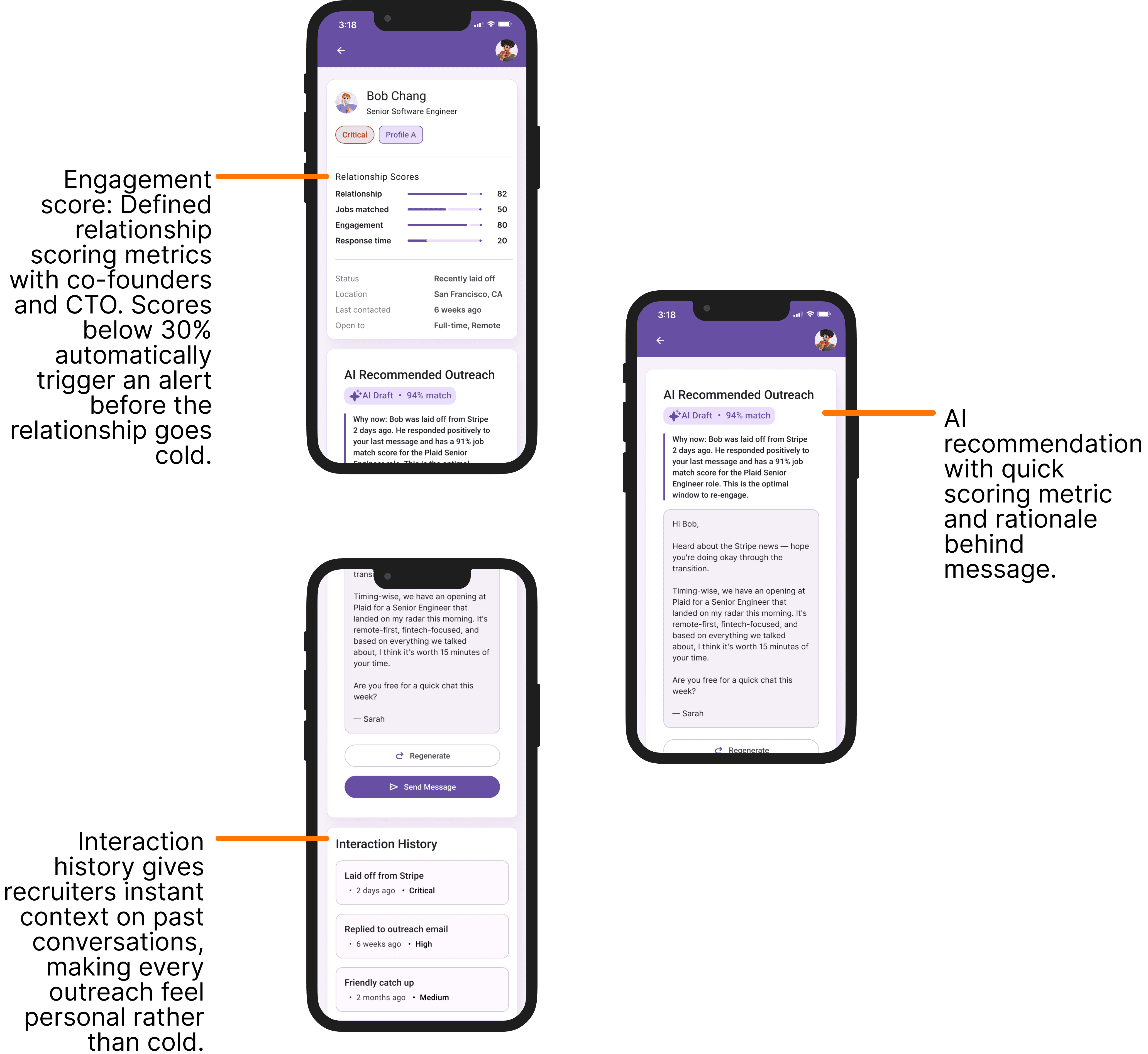
Summary contact card with engagement score breakdown, allowing recruiters to assess relationship health and urgency at a glance; without opening a single conversation thread.
Interaction history timeline for quick recall of past convos
AI recommended message with rationale behind the message
AI-Generated Screens Built with Figma Make
For the AI Recommended Messaging screens, I used Figma Make instead of designing from scratch. I fed it the full context: algorithm logic, data points, profile type examples, user flow, design system, and existing prototype, and let it generate the screens.
The design thinking, constraints, and context were mine. The screen generation was Figma Make's. This freed me up to focus on refining the output rather than producing it.

Figma Make
The Business Conflict
The Prototype Was Ready. Then Came the Hard Question
Does this really need months of dev time to build the backend infrastructure? Or can we leverage existing AI tools to help us achieve the same outcome?
The CTO's plan was to spend 3+ months building custom AI infrastructure from scratch before a single recruiter could touch the product. The founders wanted to move fast but didn't have the technical background to challenge it. So the plan stood. By default.
I didn't think we needed to build any of it.
My hypothesis was that existing AI tools could simulate the entire workflow — relationship analysis, prioritization, personalized outreach — without a single line of custom infrastructure. But a hypothesis isn't an argument. And an argument wasn't going to move anyone.
So I gave myself one week to prove it.
My Experiment
Proving AI Can Read Relationships Like a Recruiter
In one week, I simulated the core functions of this product using Claude.
My goal was to test whether AI could interpret complex human relationships and take meaningful action, without any custom infrastructure.
The Context I Fed Into Claude
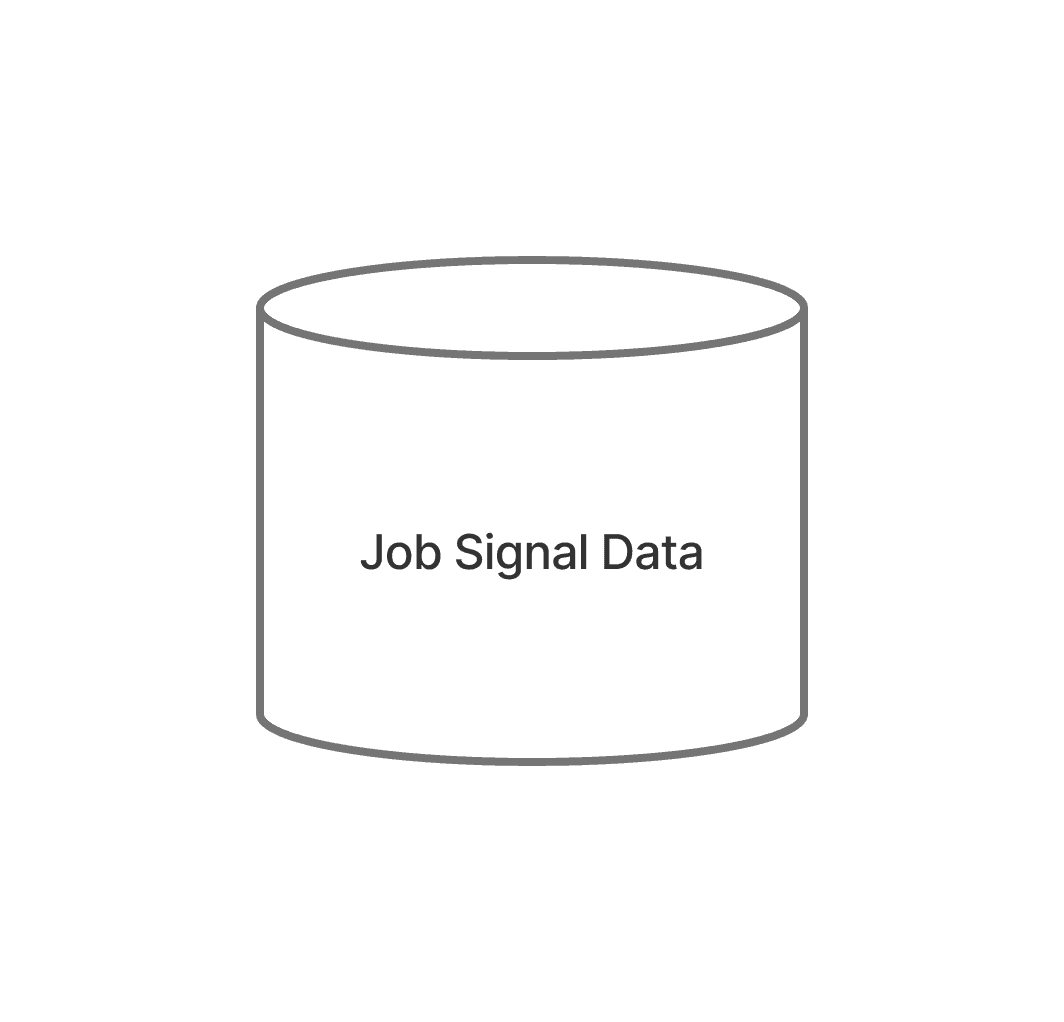
I fed 3 real recruiter contacts' convo histories into Claude, along with the engagement score algorithm, job signal data, and profile type examples.

Engagement Score Algorithm Formula

Kelsey Walker
VP Talent, Rio Finance
Warm Long-term Partner
4-year relationship. Helped Kelsey build recruiting processes at UnitC. She now runs her own firm and refers clients to Sam regularly.
Relationship strength
Last contact
Business opportunity
"Mentioned spending Christmas in Quebec City with Silas. Both share Canadian roots — Sam recently moved to Vancouver."
Matt Lange
Controller, Skylo Technologies
Transactional + Recent
Past successful placement of Andy Lai. Matt now needs another hire AND is job-searching himself. Dual role as client and candidate.
Relationship strength
Last contact
Business opportunity
"Shares an interest in US Open tennis. Specifically asked for candidates like Andy Lai — a high bar and a clear brief."

Tyler Phong
Head of Finance, TRM Labs
High-Opportunity, Neglected
43 days since last contact. Actively struggling with hiring. Agreed to refer Sam to his talent leader — but never followed through.
Relationship strength
Last contact
Business opportunity
"Exchanges Chinese New Year greetings with Sam. Based in Austin. Uses emojis — casual rapport despite infrequent contact."

Claude Understood Personal Relationships, Timing, Opportunities
Relationship Understanding
Decoded relationship depth from tone, not just content
Identified Kelsey as a mutual-value partner, not just a client. Noted reciprocal referrals and multi-year trust without being prompted.
time awareness
Calculated recency gaps and
flagged urgency independently
Surfaced Tyler's 43-day silence as the highest-risk gap. Matched timing to open opportunities without explicit instruction.
Opportunity Detection
Mapped relationship warmth to business value
Scored Matt as 25/25 criticality — maximum urgency combined with proven placement history. Identified dual client- candidate dynamic unprompted.
Personal Context Recall
Retained human detail across every output
Referenced Quebec City Christmas, US Open tennis, Andy Lai by name in outreach. Personal details surfaced naturally, not mechanically.
Claude Turned Raw Conversations to Ranked Priorities in Seconds
AI Decision Output — Who to contact first
1
Matt Lange
Fresh job posting + proven placement history + active brief. Move immediately.
● High confidence — 25/25
2
Tyler Phong
Longest gap. Active hiring need. Referral promise left unresolved.
● Medium confidence — 15/25
3
Kelsey Walker
Strong relationship, but older posting. Nurture, don't push.
● Moderate — 10/25
Claude Drafted a Message That Felt Human with Personal Reference, Business Hook, Natural Tone.
Proof of depth — AI-drafted outreach for Tyler
100% accepted as-is
Hey Tyler,
Hope the
Year of the Dragon
I've been thinking about our conversation - you were getting
almost no response on that Strategic Finance search,
I have some thoughts on why top IB + strat fin profiles aren't biting, and a few names who might actually be interested. Worth a quick catch-up?
Personal reference
Business hook
Experimentation Yielded 100% Draft Acceptance Rate
The AI-generated messages were good enough that recruiters barely edited them. The experiment proved we didn't need custom infrastructure.
We scrapped the original plan, redirected the roadmap, and recovered 3 months of development time.
100%
100% acceptance rate across 10 AI-generated drafts; recruiters sent each message without editing.
3 MO
3 months saved against the CTO's proposed custom infrastructure build.
What Happened Next?
The experiment did its job. In one week, it proved that existing AI tools could replicate the core product functionality: relationship analysis, prioritization, and personalized outreach, without custom infrastructure.
The findings shifted the conversation. The team used the results to reassess the technical roadmap and paused development to reconsider resourcing and next steps.
The product hasn't shipped yet. But the experiment changed what it will be, and saved three months of building in the wrong direction.
What I'd do differently
10 drafts across 3 contacts is a strong signal, not a proof. I'd run a broader test: 50+ drafts across more recruiters and relationship types before calling the AI approach fully validated. I'd also want to measure edit rate more rigorously: not just whether recruiters sent the draft, but how much they changed it and why.
The Best Product Decision Wasn't a Design Choice
It was knowing when to challenge a technical assumption before the team spent months building the wrong thing. One week of experimentation replaced 3 months of planned development, and redirected the entire product roadmap.